

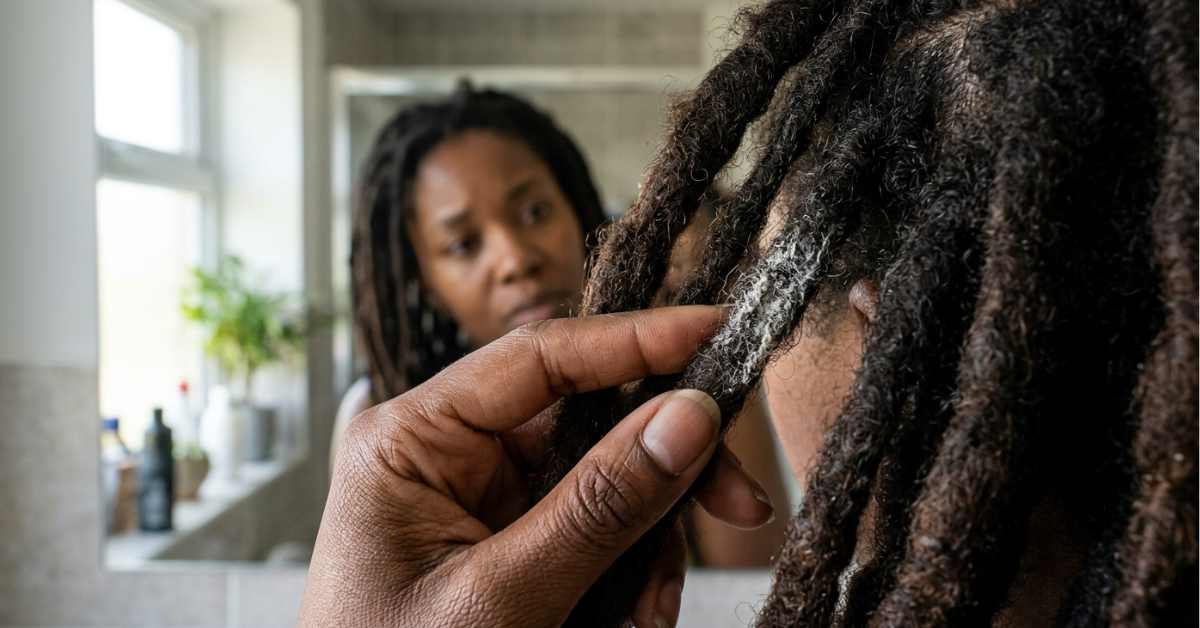
White buildup on locs is one of those things that catches you off guard. You’re going about your day, catch a glimpse of your hair in the mirror, and suddenly notice a chalky film, some white flecks, or a dull residue sitting on your locs that definitely was not there before.
You start wondering if you’ve been washing wrong, using the wrong products, or if something is seriously off with your hair.
The white residue on your locs after washing, the lint, the white stuff in your locs that won’t budge. These are some of the most common things people with locs deal with, and yet almost nobody talks about them directly.
Here’s the thing most articles skip over: white buildup on locs is not one problem. It’s four completely different problems that happen to look similar. And that matters a lot, because knowing how to remove buildup from locs depends entirely on which type you’re dealing with.
Grab the wrong fix and you could waste weeks treating something that needs a completely different approach, or worse, damage your locs in the process.
So before you reach for anything, let’s figure out exactly what you’re looking at.
Why Locs Get White Buildup More Than Other Hair Types

If you had loose natural hair before starting your loc journey, you probably noticed that buildup was easier to deal with then. A good wash and your hair was clean. With locs, it’s a different story, and there’s a simple reason for that.
Locs are essentially compacted hair. As they tighten and mature over months and years, the strands inside them lock together more and more densely. That density is what makes locs so beautiful and strong, but it also means that whatever goes into your locs does not come out as easily.
Product settles deep inside the loc rather than rinsing off the surface. Minerals from your tap water get trapped in the same way. Fibres from your pillow or hat get caught and hold on.
Think about rinsing a sponge versus rinsing a tightly packed cloth. The water passes straight through the sponge, but in the cloth, things get stuck. Your locs work in a similar way, especially once they’ve fully locked.
On top of that, the longer you’ve been on your loc journey, the more layers of product, water minerals, and other residue can build up inside each loc. This is not a hygiene issue.
Most people with loc buildup are washing regularly. The buildup comes from the structure of locs themselves, not from skipping wash days. Hard water buildup is a particularly sneaky one because you can’t see or smell the minerals in your tap water.
They accumulate silently over months until one day your locs look dull, feel stiff, and you can’t figure out why.
Now let’s actually look at what type of buildup you’re dealing with.
The 4 Types of White Buildup on Locs: How to Tell Them Apart

This is the section that will save you the most time and frustration. Read through each type carefully and compare it to what you’re seeing in your own hair.
1. Product Buildup (The Most Common Type)
Product buildup is what most people are dealing with when they first notice white stuff in their locs. It happens when the products you use on your hair do not fully wash out, and instead they layer up inside your locs over time.
What it looks like: A waxy or slightly yellowish-white film, usually concentrated at the roots or in the sections where you apply product the most. When you touch those locs, they feel slightly tacky or sticky, almost like there’s something coating them. The longer it’s been building up, the more visible it becomes.
What causes it: Heavy, thick products are the main culprit. Shea butter, beeswax, thick pomades, and leave-in conditioners with silicones are notorious for this.
Even some products marketed specifically for locs can cause buildup if they’re too heavy for your hair type.
Not rinsing thoroughly enough during wash days is another big factor. Many people rinse for what feels like long enough, but with locs, you genuinely need to rinse longer than you think. Layering product on top of product without a proper clarifying wash in between also lets it accumulate fast.
How to confirm it’s product buildup: Press two fingers against a loc and rub gently. Does it feel waxy or leave any residue on your fingers? Does the buildup appear mostly in the spots where you apply product, like your roots or edges? If yes, product buildup is very likely what you’re dealing with.
2. Hard Water Mineral Deposits (The One Nobody Warns You About)
This is the type of loc buildup that trips up the most people, simply because so few resources talk about it. Hard water is tap water with a high concentration of minerals, mainly calcium and magnesium.
When you wash your locs with hard water over months and years, those minerals slowly deposit themselves inside and on the surface of your hair.
What it looks like: A dull, chalky white or grey film that seems to coat your locs evenly, rather than appearing in specific spots.
Your locs might look faded or lifeless even right after washing. They can also feel rough, stiff, or brittle, almost like the texture has changed.
The key difference from product buildup is that hard water deposits appear across all your locs more or less equally, not just in the areas where you apply product.
What causes it: Simply washing your hair with hard tap water repeatedly over time. You cannot see or taste the minerals in hard water, so most people have no idea they’re building up until the effects become obvious.
If you’ve moved to a new area and suddenly started having issues with your locs feeling dull or stiff, check whether your new location has harder water than your previous one.
How to confirm it’s hard water: Look at your locs. Does the film or dullness appear consistently across all of them, rather than being concentrated in certain spots?
Do your locs feel rough even when freshly washed? Now look around your bathroom. Do your taps or showerhead have a white crusty lime scale around them?
If the answer to these questions is yes, hard water deposits are likely what you’re dealing with. A regular shampoo will not touch these. You need a specific approach, which we will cover below.
3. Lint and Fibre Trapping
Lint in locs looks like white buildup but it’s actually a completely different problem. Rather than a substance depositing inside your locs, lint is tiny fibres from fabric getting physically trapped in your hair.
What it looks like: Small white, grey, or light-coloured flecks or fuzz sitting on or embedded in your locs.
Unlike product buildup or hard water deposits, lint looks more like little pieces of fluff rather than a film or coating.
Hold your locs up to a bright light and look closely. You will actually be able to see individual fibres if it is lint.
What causes it: The main sources are cotton pillowcases, cotton towels, wool hats, scarves, and hoodies. Every time your locs rub against fabric, tiny fibres can break off and get caught in your hair.
Sleeping without a bonnet or satin pillowcase is one of the biggest contributors. The more mature and tightly locked your locs are, the more aggressively they grip onto passing fibres.
How to confirm it’s lint: Take a loc and hold it close to a light source. Can you see actual threads or fibres in there?
Does the problem seem worse after sleeping without a bonnet, or after wearing a wool hat or cotton hoodie?
Lint tends to be more of a textural and visual issue than something you can feel between your fingers the way product buildup feels.
One important thing to know about lint before we get to removal: it is the hardest type of buildup to deal with, and the honest answer is that prevention is far more effective than removal. We will talk about why in the next section.
4. Dry Scalp Flaking (Not Actually Buildup on Your Locs)
This one often gets confused with loc buildup because the flakes can land on your locs and look like white residue. But the source is completely different, and so is the fix.
What it looks like: White or silvery flakes sitting on the scalp between your locs, or on the surface of locs near the roots.
The flakes are loose and fall off when touched rather than being attached to or embedded in the loc. There is often some itching that comes with it.
What causes it: A dry scalp, seasonal changes in humidity, or a condition called seborrheic dermatitis (which is basically persistent scalp flaking that does not go away on its own).
Over-washing your locs can actually make this worse by stripping the natural oils your scalp needs to stay balanced.
How to confirm it’s a scalp issue: Is the flaking coming from your scalp rather than from inside the locs themselves? Do you feel itchy? When you part your locs and look at your scalp directly, does the skin look dry or irritated?
If the white stuff is loose, sitting on top rather than embedded, and your scalp feels dry or itchy, your scalp is the issue, not the locs.
How to Remove White Buildup from Locs, by Type

Now that you’ve identified what you’re dealing with, here is exactly how to address each one.
For Product Buildup: Apple Cider Vinegar Rinse
An apple cider vinegar rinse is the most accessible and effective first step for product buildup. The mild acidity in ACV breaks down product residue and helps lift it out of the loc.
Here’s how to do it properly:
Start by mixing one part apple cider vinegar with four parts warm water in a bowl or spray bottle.
Do not skip the dilution. Undiluted ACV is too strong for regular use on your hair.
Wet your locs thoroughly first, then pour or spray the mixture evenly over your hair, making sure it reaches the roots.
Let it sit for five to ten minutes, because this is the time it needs to actually work. Do not rush it.
After that, rinse very thoroughly. Follow with a residue-free shampoo to remove any remaining ACV smell and residue.
One thing to avoid after an ACV rinse: skip the heavy conditioner. If you apply a thick conditioning treatment right after, you’re essentially putting new product residue back in immediately.
Instead, use a lightweight leave-in spray if your hair feels dry, or skip the conditioner altogether on that wash day.
For stubborn product buildup, a clarifying shampoo used once a month can also be very effective. Look for one specifically designed to remove buildup.
These are stronger than your regular shampoo and should not be used every wash day, but they’re very good for a deeper clean when ACV alone isn’t cutting it.
For Hard Water Deposits: Mineral-Stripping Shampoo or Citric Acid Rinse
Because hard water deposits are mineral-based rather than product-based, an ACV rinse alone won’t fully clear them. You need something that is specifically designed to pull minerals out of hair.
The first option is a mineral-stripping shampoo, sometimes called a chelating shampoo.
In simple terms, these shampoos contain ingredients that grab onto mineral deposits and lift them out during washing. You can find these at most beauty supply stores.
Wet your locs fully, apply the shampoo generously, and really work it through from root to tip. Rinse more thoroughly than usual because hard water deposits take longer to shift.
Give yourself extra rinsing time. Use this treatment once a month if you live in a hard water area.
The second option is a citric acid rinse, which works similarly to ACV but is often more effective specifically on mineral deposits.
Mix about one teaspoon of citric acid powder (widely available online) in two cups of warm water, apply to wet locs, wait five to ten minutes, and rinse very well.
Beyond treating the problem, the most effective long-term fix for hard water is a shower filter. These attach directly to your showerhead and filter out the calcium and magnesium before the water ever hits your hair.
It’s a simple change that makes a significant difference over time, and it protects your locs on every single wash day without you having to think about it.
For Lint: Honest Prevention Over Miracle Cures
Here is the part that most loc care articles get wrong, so let’s be straightforward about it. Once lint is embedded deep inside a mature, tightly locked loc, it is very difficult to remove fully without damaging the loc itself.
Some people spend hours trying to pick it out and end up with more damage than they started with.
For newer locs where the lint is sitting on the surface rather than trapped inside, you can use a fine-tooth comb, a small loc tool, or even clean tweezers to carefully lift the fibres off. Work slowly and with light pressure. The goal is to lift the lint, not to pull at the loc itself.
For mature locs with lint that’s been embedded for a while, accept that full removal may not be realistic. Instead, redirect your energy toward stopping more from getting in.
The single most effective change you can make is covering your locs every night with a satin bonnet or switching to a satin pillowcase.
Cotton grabs and sheds fibres constantly against your hair as you sleep. Satin is smooth and does not. Beyond that, be mindful of cotton hoods and wool hats.
If you wear them regularly, try lining the inside with a satin layer or draping a satin scarf over your locs before putting the hat on. Prevention really is the only reliable long-term answer for lint.
For Dry Scalp Flaking: A Scalp Oil Routine
Because this is a scalp issue rather than a loc issue, treating the locs themselves won’t help. What your scalp actually needs is moisture and balance.
Start by adjusting how often you wash. If you’re washing more than once a week, that’s likely stripping too much of your scalp’s natural oils.
Aim for every one to two weeks as a baseline, and see if the flaking reduces with less frequent washing.
Between wash days, apply a lightweight scalp oil directly to the skin between your locs using an applicator bottle.
Oils like tea tree, jojoba, or peppermint are good options. They absorb well, don’t leave heavy residue, and tea tree in particular has properties that help with irritated scalps.
Part your locs in sections and work the oil into the scalp systematically so you don’t miss any areas.
If the flaking continues despite these changes, or if the itching is significant and constant, it’s worth seeing a dermatologist.
Persistent scalp flaking that doesn’t respond to basic care can sometimes be seborrheic dermatitis, which is very treatable but needs the right approach.

How to Stop White Buildup Coming Back
Once you’ve dealt with the immediate problem, the goal is to make sure it doesn’t come back in full force. The good news is that prevention is much simpler than removal.
Choose your products carefully. The lighter the product, the less likely it is to build up inside your locs. Water-based products, lightweight sprays, and diluted oils are generally much safer than thick butters, waxes, and creams. If a product leaves your fingers feeling waxy or greasy, it will do the same inside your locs.
Rinse for longer than feels necessary. Most people under-rinse during wash day. With locs, you need to rinse until the water running off your hair is completely clear, and then rinse for another thirty to sixty seconds after that. It sounds excessive, but it makes a real difference in how much residue stays behind.
Add a monthly clarifying wash to your routine. Whether that’s an ACV rinse, a chelating shampoo, or a citric acid rinse, one deeper cleanse per month gives buildup no chance to accumulate to problem levels.
Protect your locs every night. A satin bonnet or satin pillowcase every single night. This one habit prevents lint, reduces frizz, protects your retwist, and keeps your locs cleaner for longer. It’s the easiest, most effective thing you can add to your routine.
Use a shower filter if you’re in a hard water area. Once you start one, you’ll notice the difference within a few weeks.
Here’s a simple routine to keep everything under control:
|
How often |
What to do |
|
Every wash day |
Rinse for an extra 60 seconds after you think you’re done |
|
Once a month |
ACV rinse or clarifying shampoo |
|
Every night |
Satin bonnet or satin pillowcase |
|
Every 4 to 6 weeks |
Quick visual check on your locs for early signs of buildup |
Frequently Asked Questions
Is white buildup in locs a sign of bad hygiene?
Not at all. Buildup in locs is caused by product chemistry, the mineral content of your tap water, and the physical structure of locs, not by how often or how carefully you wash.
In fact, some people with very consistent wash routines still develop hard water buildup simply because of where they live.
If you’ve been washing regularly and still have buildup, you are not doing anything wrong. You just need the right type of cleanse for the right type of buildup.
Can I use regular conditioner to remove buildup?
No, and this is a mistake worth avoiding. Most conditioners contain ingredients that coat the hair, which is great for softness, but it adds to buildup rather than removing it.
For actual buildup removal, you want a clarifying shampoo or an ACV rinse, not a conditioner. Save the conditioner for after you’ve done the cleansing step, and even then, go light.
How do I know if my locs have too much buildup?
A few clear signs: your locs feel waxy or sticky when you touch them. They look dull or faded even right after washing.
There’s a musty or sour smell that doesn’t go away with regular washing. Or there’s a visible white or grey coating that you haven’t been able to rinse out. If any of these sound familiar, it’s time for a clarifying treatment.
Will an apple cider vinegar rinse damage my locs?
When you dilute it correctly, no. The key ratio is one part ACV to four parts warm water.
At that dilution, it’s gentle enough for regular monthly use. Where problems can arise is if you use it undiluted, use it too frequently, or leave it on for longer than fifteen minutes.
Keep to those guidelines and it’s a safe, effective treatment.
How often should I clarify my locs?
Once a month works well for most people as a starting point. If you use heavier products, work out regularly and sweat a lot, or live somewhere with hard water, every two to three weeks is more appropriate.
On the other hand, if you use very lightweight products and have soft water, every six weeks might be enough. Start with monthly and adjust from there based on how your locs look and feel.
The Right Fix Starts with the Right Diagnosis

White buildup on locs is frustrating precisely because it looks the same no matter what’s causing it. But once you know what you are actually dealing with, whether product residue, hard water minerals, lint, or dry scalp, the fix becomes much more straightforward.
Product buildup responds well to an ACV rinse or clarifying shampoo. Hard water deposits need a mineral-stripping wash or citric acid rinse, plus ideally a shower filter going forward.
Lint is best managed through prevention, starting with a satin bonnet every night above all else. Dry scalp flaking needs scalp care, not loc care.
Most loc buildup is fully manageable once you know which type you have. The information is out there; it just tends to be scattered across a dozen different sources that each only cover one piece of the puzzle. Hopefully this gives you everything in one place.
If you want to go further, take a look at the loc-safe product guide for a breakdown of which ingredients to look for and which to avoid on your next shop. And if you’re still figuring out your wash day routine, the guide to washing starter locs without unravelling walks through the full process step by step.
Got questions about your specific situation? Drop them in the comments below. Loc journeys are all different, and sometimes the answer is in the details.